Consumer research
Forex signal bid, ask and reference-price accounting
Work through a long and short quote example, identifying embedded spread before subtracting cash costs.
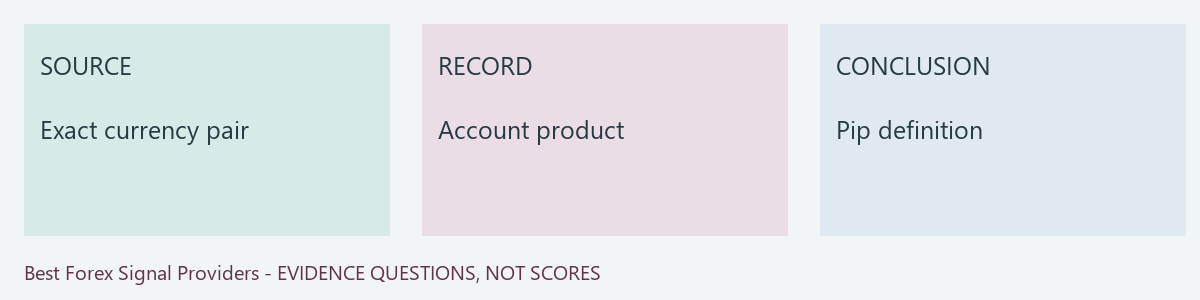
Declare the price convention before using a pip total
A forex instruction can quote a chart level, a midpoint, a bid, an ask or a desired order level. Those are not interchangeable observations. Write the convention next to the original entry and exit. If it is missing, preserve that uncertainty rather than promoting a convenient chart print into a confirmed executable price. Record the actual broker contract and quoted quantity as separate fields.
For a declared long example, the opening purchase uses the ask and the closing sale uses the bid. A short reverses those economic sides. A displayed spread is the difference between contemporaneous sides, not automatically a cash deduction for every ledger. The question is whether executable sides are already embedded in the outcome being measured.
Two coherent ledgers, not two charges for one spread
A reference-price ledger can compute gross movement first and deduct a declared difference between reference prices and executable prices. An actual-fill ledger begins with the observed execution prices; those prices already contain the crossing of quoted sides. Subtract commissions and separately booked financing once. Adding a second generic spread charge to the fill ledger can distort the result just as omitting execution friction can.
Document the convention consistently across wins and losses. If one record uses midpoint entries and another actual asks, their pips are not yet comparable. Preserve both raw prices and the transformation rather than repairing the series with a universal assumed spread. A broker statement, quote observation and publisher message can have different clocks.
Distinguish a visible level from an accepted operation
An order intention has a type, requested quantity and validity rule. It can be rejected, expire or fill differently from the displayed quote. The publication clock does not establish any of those states. Keep acceptance and fill observations alongside the source instruction; an absent order record must stay absent rather than being inferred from a favourable candle.
For coarse historical data, a bid or ask high does not necessarily establish available size or path order. If both stop and target appear inside one interval, suitable finer evidence may still be needed. Do not make every unresolved event a winner or presume a stop is guaranteed at its requested level.
Use a conclusion limited to the represented records
A completed quote-side calculation is a unit translation under assumptions, not evidence that a real subscriber captured the move. A useful provider comparison can state that original instructions are readable while execution remains untested. That is more precise than collapsing clarity, chronology and profitability into a single verified badge.
Carry the source period, pair, pip increment, quantity, conversion and separate costs into any export. Recheck the final figure against the raw price difference. If a report cannot reproduce one row without choosing a new convention after the outcome, its aggregate should not be described as reproduced.
Completed fictional case
Fictional long case: reference entry 1.1000 and reference exit 1.1025 give 25 pips at a 0.0001 increment. Actual ask entry 1.1001 and bid exit 1.1024 give 23 pips. For 10,000 base units, actual gross is 23 quote-currency units. With 1 commission and 0.5 financing paid, net is 21.5. Do not deduct the same two-pip difference again. A fictional short from actual bid 1.1024 to closing ask 1.1001 also gives 23 pips before separate charges.
| Record | Represented finding | Boundary |
|---|---|---|
| Reference path | 25 pips | No fill assertion |
| Actual-price example | 23 pips / 23 quote units | Spread difference embedded |
| Separate costs | 1.5 quote units / 21.5 net | Same-currency classroom assumptions |
Primary sources and scope
Source inspection: 12 October 2026. Sources describe mechanisms or product categories, not the invented case outcomes. No paid product, account or copying pipeline was connected for this edition.