Consumer research
Forex rollover, financing and cost-ledger comparison
Reconcile fictional financing debits and credits while separating broker schedules from generic overnight assumptions.
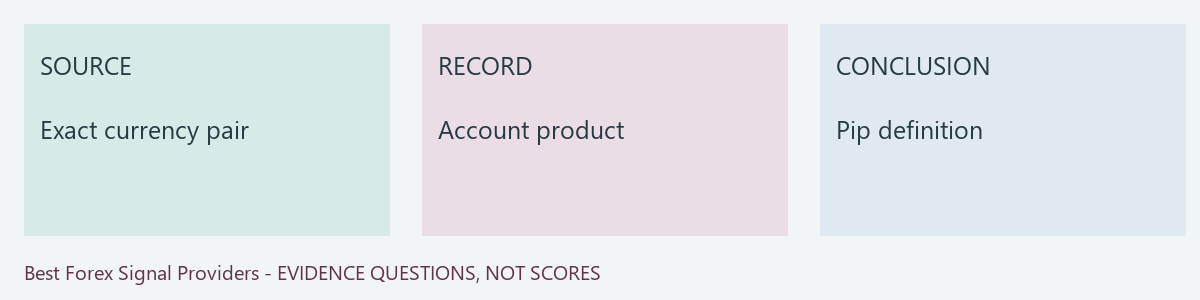
Obtain the dated account rule
An overnight charge depends on the actual product, account, direction, quantity and broker schedule. A generic claim that forex has a particular rollover day cannot establish what a historical account paid. Preserve the dated contract terms and booked statement entries. Holiday handling, product changes and different account types should not be guessed from a present-day marketing page.
Record a financing credit as a credit and a debit as a debit. The sign convention must be explicit before aggregation. A source reporting positive swap points can use a convention different from cash debited to a particular account. Translate with the applicable units rather than assuming points are already account money.
Count actual booking events, not calendar adjectives
Holding for three calendar nights does not independently establish three identical financing entries. The event schedule and actual account record decide the charges. A statement can book an amount that covers a non-trading interval or a changed rate. Reconcile the observed events without inventing a universal triple-day multiplier.
A flat cost sensitivity can still be useful when properly labelled. Use it to examine whether an assumed per-event debit overwhelms a hypothetical signal edge, not to claim the historical statement was reproduced. If a broker entry is missing, carry an unresolved financing component beside the gross result.
Do not combine fees in unlike currencies blindly
Commission, financing and subscription charges may be expressed in different currencies and booked on different dates. A net calculation needs an explicit conversion basis for each. Subscription allocation is a separate analytical choice: spreading a monthly bill across only winning trades makes those winners look artificially cheap and hides the full commitment.
A broker deposit is not a consumption cost like a membership fee, although it carries its own custody and market risks. Keep it outside the same expense subtotal. A minimum balance or funded account requirement can be economically important without being mislabelled as a subscription price.
Make the comparison reproducible
For each represented trade, retain gross fill-price contribution, separately booked commissions, financing debits and credits, and any allocated subscription cost. Name every allocation rule. The resulting cost-adjusted hypothetical outcome should not be called an audited subscriber return unless the actual account and its complete population have been independently examined.
An affordable room can still require more attendance time or have a contract that makes small positions uneconomic. Compare that operational burden as a different column instead of deriving a performance score from price. An unexplained zero financing figure is not proof that a product incurs no overnight costs.
Completed fictional case
Fictional statement: gross fill contribution is 18 account units, commission is a 1.2 debit, financing entries are debits of 0.4 and 1.1 plus a credit of 0.2. Financing net debit is 1.3; result after those booked costs is 15.5. If a separately declared membership allocation is 2, the analytical after-membership result is 13.5. These invented entries establish no broker schedule or current swap quote.
| Record | Represented finding | Boundary |
|---|---|---|
| Financing debits | 1.5 units | 0.4 + 1.1 |
| Financing credit | 0.2 units | Net financing debit 1.3 |
| Net result | 15.5 before membership allocation | Do not infer a broker schedule |
Primary sources and scope
Source inspection: 12 October 2026. Sources describe mechanisms or product categories, not the invented case outcomes. No paid product, account or copying pipeline was connected for this edition.